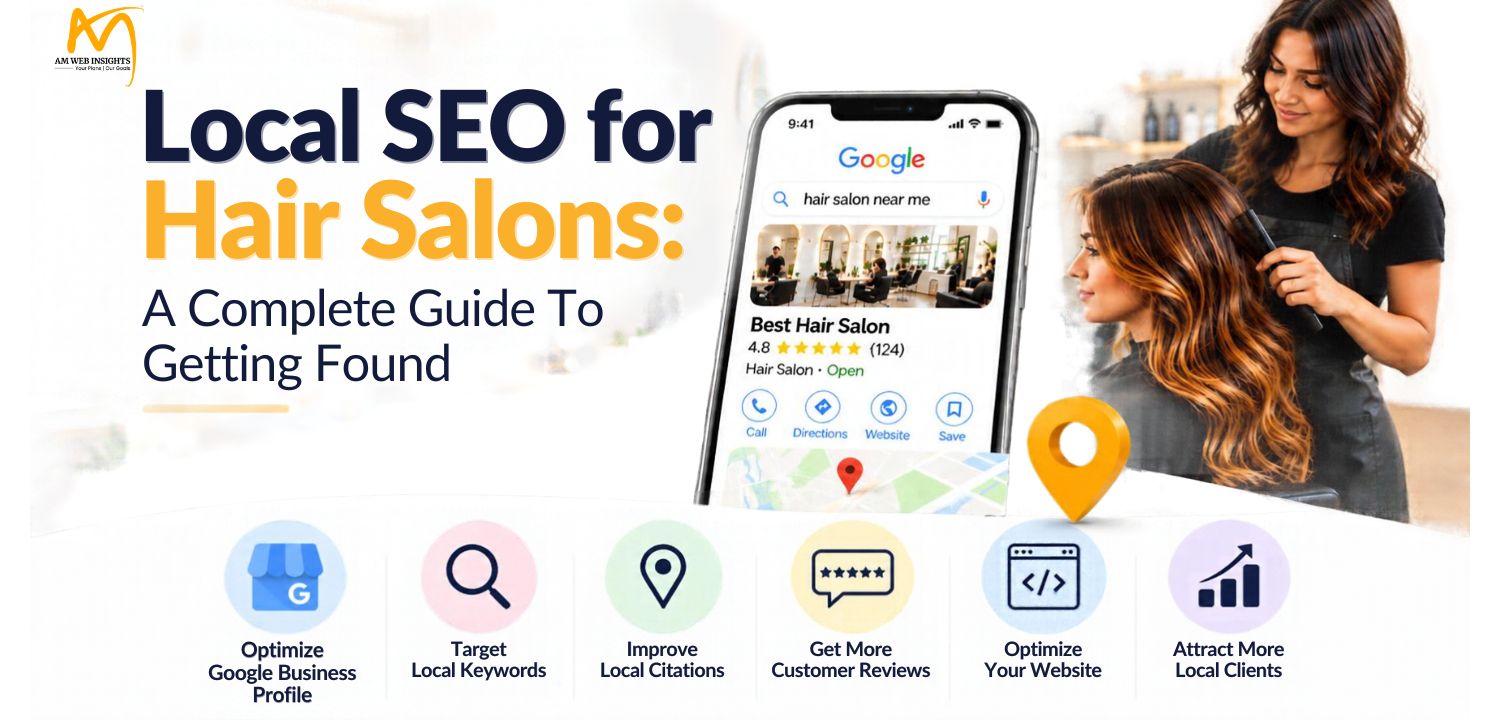
You can have the best stylists in town, five-star reviews, and a fully booked chair every Saturday – and still be nowhere to be found when someone nearby searches for “hair salon near me.” A great salon isn’t automatically a visible one. Being skilled at your craft doesn’t tell Google’s local algorithm you exist, or convince it you’re the right result for that specific searcher.
Visibility in local search runs on its own set of rules, separate from the quality of service you actually provide – and without understanding those rules, even the best salons can stay invisible to the very clients searching for them right now. So what actually determines whether your salon shows up – and how to do seo for hair salons?
How Does Local SEO for Hair Salons Work?
Local SEO for a hair salon captures high-intent clients at the exact moment they search for nearby services. Instead of broad advertising, it builds your salon’s digital authority across your specific neighborhood through hyper-local content, targeted service pages, and location-rich customer feedback. Search engines evaluate these local signals, review keywords, and website structure to verify your geographic relevance, ensuring your salon ranks prominently when potential clients look for a stylist nearby.
Which One to Focus On: Traditional SEO or Local SEO
- Traditional SEO: Traditional SEO is an important part of salon SEO. It focuses on optimizing your website’s content, on-page SEO, internal linking, and technical structure so search engines can understand your salon, services, and expertise. It helps your service pages and useful content rank for relevant searches beyond your local area.
- Local SEO: The process of optimizing your website and Google Business Profile (GBP) to improve visibility in local search results. It helps your salon appear when people search for relevant services in your area, driving more local website traffic, calls, and customers.
Why Do Hair Salons Need Both?
This one’s about proximity. It puts you in front of the person three blocks away who wants a haircut this afternoon. Someone searching, ready to call, ready to walk in, ready to book. Traditional hair salon SEO builds your visibility over time and ranks your service pages. Local SEO gets you found right now, by someone right nearby.
How Website SEO Drives Local Map Success
Your website and Google Business Profile act as a two-way growth engine. While your website builds your salon’s digital authority, your profile pins that authority to your exact neighborhood map.
Data Cross-Validation (The Trust Signal)
Google continuously cross-references your website content with your local profiles. When your geographic data, customer reviews, and on-page keyword details match perfectly, it validates your business’s legitimacy. This unified optimization approach establishes local relevance, directly increasing your rankings in the local Map Pack.
Organic Authority Transfer
The search authority (PageRank) built by your website’s SEO flows directly into your GBP. Linking a high-performing, well-optimized website to your profile increases your GBP’s visibility for competitive, high-intent local search queries.
Contextual Keyword Matching
Google crawls your website’s landing pages to better understand your GBP. If a user searches for a highly specific service that is not explicitly listed on your GBP, Google will still surface your profile if it detects and validates that service on your linked website.
What Influences Local Rankings?
Google doesn’t keep its algorithm a secret – it publishes the framework directly. Local search results are mainly based on relevance, distance, and popularity, and Google combines these to find the best match for a customer’s search. Google combines these factors to deliver the most accurate match for a user’s search intent.
- Relevance – how well your Business Profile matches the search term.
- Distance – how close your salon is to the searcher (or to the location they typed in).
- Prominence – how well-known and trusted your salon is, based on reviews, links, and citations.
How to Optimize Hair Salon Websites for Local SEO
A salon website needs to be completely optimized in three crucial areas – on-page, off-page, and technical SEO – to appear at the top of local search results. The framework guarantees that Google can crawl, comprehend, and believe that your website is relevant to local customers.
1. On-Page SEO
To rank for high-intent salon keywords, your website’s visible content and aspects must be optimized.
Meta Tags
To increase click-through rates, include detailed title tags and meta descriptions that highlight your main service, the name of your city, and an attention-grabbing call to action.
Heading Structure
To help search engines efficiently parse information, content should be arranged using a logical hierarchy (H1 for the primary page topic, H2s and H3s for certain services).
Service Pages
Instead of packing all of the main services (such as hair coloring, bridal style, and haircuts) onto one page, separate, dedicated pages should be created for each.
Internal Linking
Structuring text links between your pages (e.g., linking from a blog post about hair health directly to your treatment service page) to distribute search authority throughout the site.
Image Alt Text
Adding descriptive, keyword-conscious text to the backend of images so search engines can read and index your salon’s portfolio photos.
Location-Specific Content
Embedding your specific neighborhood names, landmarks, and local directions into the copy to solidify your geographic relevance.
2. Off-Page SEO
It builds your salon’s digital footprint and authority across the broader web through third-party signals.
Business Listings & Local Citations
Publishing your salon’s Name, Address, and Phone number (NAP) consistently across core directories like Yelp, Yellow Pages, Yell, TrueLocal, and Apple Maps to validate your location.
Relevant Backlinks
Earning incoming hyperlinks from authoritative, locally relevant websites to signal to Google that your business is highly trusted.
Local Blogs
Collaborating with local lifestyle or neighborhood bloggers for features and mentions that drive highly targeted local referral traffic.
Press Releases
Distributing newsworthy updates – like a grand opening, a new styling team, or a charity event – to local news websites to secure high-authority regional backlinks.
3. Technical SEO
This focuses on optimizing your website’s infrastructure, so search engine spiders can crawl, index, and render your site without errors.
Website Speed
Optimizing page loading times, visual stability, and interactivity metrics to meet Google’s user-experience performance benchmarks.
Mobile Responsiveness
Ensuring the website automatically scales and functions flawlessly on smartphones, where the vast majority of “near me” local searches occur.
XML Sitemap & Robots.txt
Maintaining an updated sitemap file to guide search crawlers to your important pages, paired with a robots.txt file to block them from indexing irrelevant pages.
HTTPS Security
Protecting user data and booking inputs with an active SSL certificate, which functions as a foundational Google ranking signal.
Clear URL Structure
Using clean, readable URL paths (e.g., ://salon.com) instead of chaotic, system-generated strings.
Local Business Schema
Adding structured data markup to the site’s code to give Google precise details about your address, operating hours, and coordinates.
Review Schema
Utilizing structured data to display star ratings directly in organic search engine results pages (SERPs), increasing visibility and user trust.
How to Optimize Your Google Business Profile for Hair Salons
Your Google Business Profile (GBP) is your primary tool for capturing local search intent. Optimizing your profile ensures your salon surfaces at the top of Google Maps when nearby clients look for styling services.
Complete Every Profile Field
Input your business name, address, phone, exact hours, website, and a direct booking link.
Maintain Strict NAP Consistency
Ensure your Name, Address, and Phone number are identical across your website, GBP, directories, and social media.
Select Precise Categories & Services
Set your primary category to “Hair Salon” and add specific service tags like hair coloring, balayage, hair extensions, and blow-dries.
Manage Customer Reviews
Gather genuine client reviews, respond to all feedback, and handle negative comments professionally.
Publish Regular GBP Posts
Frequently share updates about your services, offers, treatments, and seasonal promotions.
Upload Photos and Videos
Add high-quality visual content of your salon space, team, and client hair transformations.
Why Local Rankings Depend on Website and GBP Together
A common mistake is treating your website and your Google Business Profile (GBP) as separate entities. In reality, they form an interdependent system. Optimizing only one is never enough: a great website without a GBP lacks geographic anchoring, while a GBP without a strong website lacks the search authority needed to rank for competitive terms. They must work together to dominate local search.
1. How Your Website Supports Your GBP
Your website provides a deep informational context that your GBP cannot fit.
- Service Pages: Dedicated pages for specialties like balayage or extensions give Google’s crawlers the data it needs to rank your GBP when users search for those specific services.
- Location & Business Details: Embedding your physical address, local schema code, and consistent NAP data on your site validates the authenticity of your GBP, building algorithmic trust.
2. How Your GBP Drives Website Discovery and Actions
Your GBP acts as the visual conversion engine directly inside search results, channeling traffic back to your digital assets.
- Visibility: It places your business prominently in Google Maps and the high-visibility Local Three-Pack results.
- Direct Actions: It provides immediate buttons for customer interactions, allowing users to read reviews, make direct calls, click through to your website, or complete bookings without leaving the search page.
3. In Action: The Journey of a Local Search
To understand how these elements collaborate, look at how a customer moves from an initial search to an appointment booking:
[Customer Search] ──> “best blonde colorist near me”
│
v
[Google Algorithm] ──> Checks GBP for location proximity & reviews
│ ──> Scans linked Website for “blonde colorist” content
│
v
[The Result] ───────> Salon surfaces in the Local 3-Pack
│
v
[Customer Action] ──> Reads GBP reviews ──> Clicks “Book Online” to Website
When a user types a high-intent phrase like “best blonde colorist near me,” Google immediately scans the searcher’s proximity. However, it also crawls your linked website to verify you actually have expertise in blonde coloring. If the data aligns, Google displays your salon in the Map Pack. The customer reads your positive GBP reviews, clicks your profile’s website link, and lands on your optimized service page to book their appointment.
How to Look for the Right SEO Keywords for a Hair Salon
The gap between what your hair salon offers and what prospective customers enter into a search bar is filled by keyword research. You must choose high-intent terms for your website, assess them according to certain criteria, accurately map them, and use the appropriate tools to get the right kind of traffic.
1. Website Keyword Research
Your website needs structural keywords tailored to different stages of the client journey. These phrases dictate your organic visibility across search engine results pages:
- Homepage: Target broad, high-volume brand or primary categorical definitions that summarize your entire business (e.g., “hair salon in [City]”).
- Service Pages: Hyper-focus on specific treatments to capture explicit, revenue-driving service demand (e.g., “balayage specialist”, “keratin treatment”).
- Location Pages: Use dedicated pages if you have multiple branches, anchoring each page to a specific neighborhood, borough, or suburb.
- Blogs: Focus on informational intent and answering common client questions (e.g., “how to maintain bleached hair”).
2. Criteria for Keyword Selection
Not every keyword is worth targeting. Filter your researched phrases using these core metrics:
- Search Intent: Prioritize commercial or transactional intent (users ready to book a chair) over purely informational queries.
- Service & Location Relevance: Ensure the phrase matches a service you actually provide in the exact geographic area you serve.
- Search Volume vs. Competition: Target a healthy balance of high-volume terms (harder to rank for) and lower-competition phrases (easier to win quickly).
- Long-Tail Keywords: Focus on longer, more specific phrases (e.g., “organic hair coloring salon near me”). While they have lower search volumes, they convert at a significantly higher rate because the client knows exactly what they want.
3. Keyword Mapping: Website vs. Google Business Profile
Once you have your list of hair salon keywords, you must map them to the proper digital asset so they support each other rather than competing:
- Google Business Profile Mapping: Map broad categorical terms (“hair salon”, “hairdresser”) and hyper-local geographical modifiers to your GBP to win map pack placements.
- Website Mapping: Map highly specific, technical service phrases, pricing keywords, and informational questions to your individual website pages and blog posts.
| Website Keywords | GBP Keywords |
| Hair Salon [City] Best Hair Salon [City] Hairdresser [City] Women’s Hair Salon [City] Haircut [City] Hair Coloring [City] Bridal hair salon [city] Hair Extensions [City] Keratin treatment salon [city] Affordable hair salon [city] | Hairdressers near me Best hair salon near me Hair salon open now Hair salon open Sunday Walk-in hair salon near me Balayage near me Blow dry near me kids haircuts near me Hair salon [neighborhood] Salon near [landmark/ area] Hair salon [city] hours |
Which Tools Actually Matter for Local SEO for Hair Salons
Choosing the right local SEO tools can feel overwhelming when you’re running a hair salon, not a marketing agency. The good news: you don’t need a dozen subscriptions to compete for local search traffic – you need the right tool for the right job. Below is a breakdown of what each tool actually does, whether it’s free or paid, and which ones matter most for showing up when someone nearby searches for “hair salon near me.”
| Tool | Keyword Research | Search Performance | Traffic Analysis | Backlinks | Local Rank Tracking | User Behavior | Free/ Paid |
| Semrush | Finds keywords nearby salons already rank for, plus local search volume and difficulty | Tracks keyword rankings over time | Estimates competitors’ and own site traffic | Audits missing backlinks | — | — | Paid (limited free) |
| Google Search Console | — | Shows which queries bring clicks and impressions to your site | Reports on clicks, CTR, and indexing issues | — | — | — | Free |
| Google Analytics 4 | — | — | Tracks visitor volume, source, and booking-page behavior | — | — | Shows how users move through the site before booking | Free |
| Ahrefs | Broad keyword and content gap research | Site-wide ranking overview | — | Detailed backlink profile and referring domains | — | — | Paid (free tools available) |
| BrightLocal | — | — | — | — | Tracks map pack position across multiple locations and search terms | — | Paid |
| Google Business Profile Insights | — | — | — | — | Shows how customers found the listings (search vs. maps) | Calls, direction requests, and website clicks from the listings | Free |
| Hotjar/ Heatmap tools | — | — | — | — | — | Visualizes scroll depth, clicks, and where visitors drop off before booking | Paid (free tier available) |
Best Local SEO Tips for Hair Salons
Implementing a few strategic adjustments can dramatically improve your salon’s visibility to nearby clients. Here are the most effective local SEO tips to outrank your local competition:
Keep business information consistent
Ensure your Name, Address, and Phone number (NAP) match perfectly across your website, Yelp, Yell, TrueLocal, and Apple Maps. Small mismatches confuse search engines and quietly drag your rankings down.
Build a strong Google Business Profile
Treat this profile as your digital storefront and your ticket into the Local Three-Pack map results. Fill out every field completely, including exact hours, a full service menu, transparent pricing, and a functional booking link.
Encourage genuine customer reviews
Reviews and ratings are heavily weighted local ranking signals. Build a steady habit of asking happy clients for feedback right after their appointments when satisfaction is highest, and ensure to reply to every review.
Create separate pages for important services
Avoid burying everything on a single, generic page. Build standalone pages for high-value offerings like balayage, keratin treatments, or bridal styling to match specific client search intent far more accurately.
Optimize for local search intent
Integrate your city, neighborhood names, and local landmarks naturally into your website’s main headers and meta tags so search engines immediately connect your site to your physical location.
Keep the website fast and mobile-friendly
Most “hair salon near me” searches happen on smartphones. Compress heavy portfolio images and clean up backend code to ensure your site loads instantly and navigates flawlessly on mobile devices.
Publish useful local content
Write blog posts or guides tailored to your regional community, such as seasonal hair care tips for your local climate or style recaps from local events, to prove your regional relevance to search engines.
Track performance regularly
Monitor your local rankings and organic traffic metrics on a monthly cadence. Local search landscapes shift rapidly due to competitor activity and algorithm updates; waiting for a quarterly glance misses too much actionable data.
How to Measure Local SEO Success
Because Google Map Pack results vary by location, tracking requires specialized geo-grid software that simulates searches from exact coordinates. Instead of biased personal phone searches, these platforms generate visual heatmaps showing your performance block by block. Incorporating these scans into your regular hair salon software local SEO workflow lets you accurately measure your true neighborhood visibility.
Website Performance Metrics
Your website tells you how visible you are in search and whether that visibility turns into action:
- Organic traffic – how many people are landing on your site from unpaid search results
- Impressions – how often your site appears in search results, even if it isn’t clicked
- Clicks and CTR (click-through rate) – how many people click through, and what percentage of impressions convert to clicks
- Rankings – where your pages land for target keywords like “hair salon near me” or “balayage [city].”
- Conversions – bookings, form fills, or calls generated directly from organic traffic
- Service page performance – which individual pages (color, cuts, extensions) are driving the most traffic and bookings, so you know what’s resonating
GBP Performance Metrics
Your Google Business Profile has its own set of signals that matter just as much, if not more, for local visibility:
- Profile views – how many people saw your listing
- Search queries – the exact terms people used to find your profile (direct, discovery, or branded searches)
- Calls – how many people tapped to call straight from the listing
- Website visits – clicks from GBP through to your site
- Direction requests – a strong signal of real-world foot traffic intent
- Reviews – volume, recency, and rating, which directly influence map pack ranking and trust
Why Rankings Alone Aren’t Enough
Here’s the catch with rankings: they’re hyper-local and personalized. A salon can rank #1 for someone standing outside its door and rank #8 for someone just two miles away – because Google’s local algorithm weighs the searcher’s exact location as heavily as the hair salon’s own local SEO signals. Checking your rank from one device in one location gives you a false sense of performance. That’s why metrics like calls, direction requests, and website visits from GBP matter more than a single ranking snapshot – they reflect real actions from real searchers, regardless of where they were standing when they searched.
Conclusion
Good local SEO for hair salons comes down to a simple balance. Your website teaches Google who you are and what services you offer, while your Google Business Profile puts you on the map when local clients search for a stylist nearby. Smart keyword research connects the two, making sure you show up for the exact phrases people type in when they want to book.
Back that up with accurate business info, real reviews, smooth site mechanics, and helpful content, and you’ll build the kind of trust that turns online searches into filled chairs. You don’t have to tackle the strategy alone. AM Web Insights can handle the local SEO heavy lifting while you focus on running your salon.
Frequently Asked Questions
1. What is the difference between local SEO and traditional SEO for a hair salon?
Traditional SEO optimizes your website’s content, structure, and technical performance so it ranks for relevant searches beyond your immediate area, while local SEO focuses on your website and Google Business Profile together to help you appear in “near me” searches and the Map Pack for people in your specific neighborhood.
2. How long does local SEO take to improve a hair salon’s rankings?
There’s no fixed timeline since it depends on your current website health, local competition, and how consistently you optimize your Google Business Profile and website together — but since Google weighs relevance, distance, and prominence (built through reviews, citations, and links), steady work on all three tends to show movement over a period of months rather than days.
3. Do I need both a website and a Google Business Profile, or is one enough?
You need both. A website without a GBP lacks geographic anchoring in local search, while a GBP without a strong website lacks the search authority to rank for competitive terms — together they form an interdependent system where your site feeds authority and context to your profile, and your profile drives visibility and direct customer actions.
4. What’s the most important ranking factor for a hair salon’s Google Business Profile?
Google bases local rankings on relevance, distance, and prominence. Of these, prominence — driven by the volume, recency, and quality of your reviews, along with citations and backlinks — is one of the few factors a salon can actively influence, which is why consistently generating and responding to genuine customer reviews matters so much.
5. Should I create one page for all my services or separate pages for each?
Separate, dedicated pages for each major service (like balayage, keratin treatments, or bridal styling) perform better than bundling everything onto one generic page, since standalone pages let you target specific, high-intent keywords and give Google clearer signals about each service you offer.

Ashu Rana
Ashu Rana is the Founder & CEO of AM Web Insights Private Limited, with 8+ years of experience in digital marketing. He specializes in SEO, Local SEO, Online Reputation Management (ORM), Google Business Profile optimization, and digital growth strategies. He has helped businesses and professionals across the USA, UK, Canada, UAE, and other global markets improve their online visibility, search rankings, and reputation.