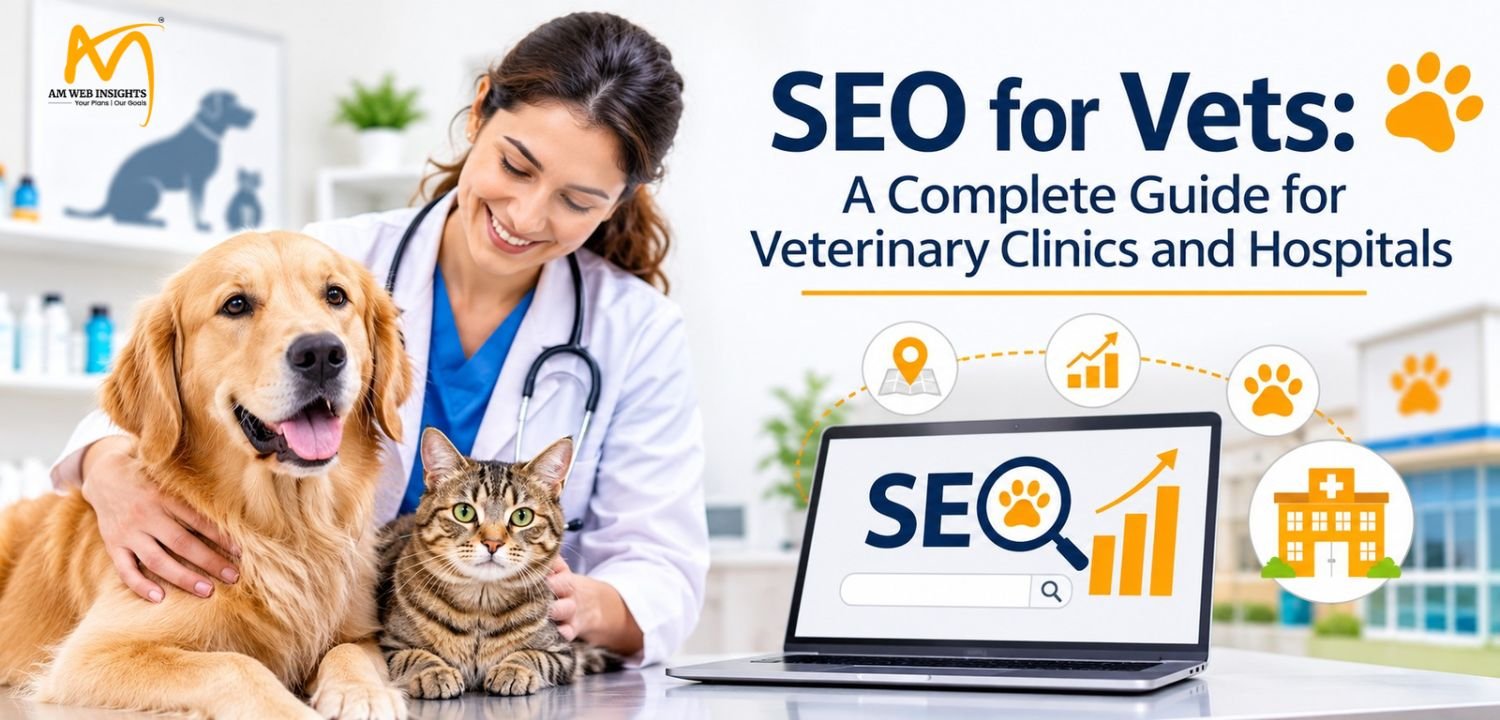
You have skilled veterinarians and caring staff, but are new patient appointments no longer increasing? Meanwhile, the clinic down the road keeps getting new clients.
You must be wondering why, being on the same street, the difference is so broad. This is SEO for vets to help with growth. That’s why they appear in the 9 pm search when a worried dog owner needs a vet.
Your website needs immediate SEO care if you want to appear in such emergency or grooming searches. This guide is for you to do the fixes first, what to skip and how to get steady calls without wasting money.
What Is SEO for Vets?
SEO for vets is simply the process of fixing up your clinic’s digital presence, so you pop up first when local pet owners use Google. When a cat or dog gets sick, the owner doesn’t look at billboards – they grab their phone and search for help.
Veterinary SEO helps improve your animal hospital’s visibility in organic search results and Google Maps, making it easier for local pet owners to discover your services.
Unlike general SEO, it rarely targets the whole country. A vet in Austin only needs clients within a short drive. That makes local search optimization a key part of veterinarian search engine optimization.
Why SEO Matters for Your Veterinary Practice
Most pet owners start with a search. They compare a few clinics, read reviews, and call the one that looks most trustworthy. If you are not visible, you are not considered.
Here is how SEO for veterinary clinics can help –
- Client acquisition – steady new-client calls without paying per click
- Lifetime client value – one pet family can stay for 10 to 15 years
- Lower cost over time – rankings keep working after the work is done
Ads stop the moment the budget stops. Strong organic visibility can continue generating enquiries over time, although rankings and traffic require ongoing monitoring and optimization.
Urgent searches add another reason. A pet owner with an emergency picks from the first few listings they see. Clinics outside those spots lose that client, often for good.
There is also a loyalty effect. Treat a pet during a dire emergency, and you’ll become the family’s regular vet.
How Pet Owners Find Vet Clinics Online
Pets have different healthcare needs, so their owners search based on that specific need. Since the searches won’t match, create separate website pages to match those specific needs.
- Emergency searches – “emergency vet open now” or “24 hour vet near me”
- Near me searches – “vet near me” or “animal hospital near me”
- Service-based searches – “dog vaccinations,” “pet dental cleaning” or “spay and neuter”
- Species-specific searches – “exotic pet vet,” “cat-only clinic” or “rabbit vet”
Then there is this anxious pet owner – worried, in a hurry, and not even comparing carefully. They click almost only on the first visible local listings.
That is why local search visibility is particularly important for veterinary clinics.
| Search type | Example query | Page that should capture it |
| Emergency | emergency vet (city) | Emergency care page and Google Business Profile |
| Near me | vet near me | Google Business Profile and homepage |
| Service-based | dog vaccinations near me | Dedicated vaccination page |
| Species-specific | exotic pet vet | Exotic pet services page |
| New client | vet accepting new patients | New client page |
| Research | How much is a dog dental cleaning | Blog post or service FAQ |
AI and voice searches follow this exact pattern. Pet parents are using their phones to ask for open clinics nearby. When your website has correct hours, clear services, and good reviews, you’re more likely to be shown in their answers.

Core Parts of Veterinary SEO
A successful veterinary SEO plan covers four main areas. Each one supports a different part of your clinic’s online visibility.
- Local SEO – Getting your clinic onto Google Maps and local listings.
- Website & On-Page – Optimizing the actual words and headers on your pages.
- Content Marketing – Writing helpful articles and guides for pet owners.
- Links & Technical SEO – Fixing behind-the-scenes site speed and building trust across the web.
Your Website: What Needs to Be in Place
Your website is where interest turns into a booking. Several pieces need to work together.
Dedicated Veterinary Service Pages
Just like one treatment can’t be the solution for every pet problem, the same way one page can’t cover all the needs of pets. So, build a separate page for each core service. That means emergency care, surgery, pet dentistry, and vaccinations each get their own page. One generic services page cannot rank for all of them.
Each page should explain the service, who it suits, and what happens during a visit. Include a clear appointment or call button so visitors know what to do next.
FAQ Sections for Veterinary SEO
Add an FAQ section to your key pages. Cover cost ranges, your walk-in policy, and what to expect at a first appointment.
These answers help real clients decide. They also give Google and AI tools short, direct passages to quote. That improves your chance of appearing in AI Overviews and People Also Ask boxes.
Mobile Speed, Click-to-Call and Schema
Most pet owners search on a phone. Your site must load fast and show a tap-to-call button at the top. Add online booking and local business schema so search engines read your details correctly.
Add a sticky call button on mobile for emergency pages. A worried owner should not scroll to find your number.
Trust Signals for Veterinary Clinics
People hand over a family member. They want proof you are qualified. Show vet bios with photos, credentials, and years of experience. Add real reviews and any association memberships.
Include a “Meet the Team” page and photos of your actual clinic. Stock images weaken trust quickly.
Local SEO for Veterinary Clinics
Local SEO for veterinarians helps your clinic show up on Google Maps. If you want nearby pet parents to see your location, you have to fix this part first before worrying about anything else.
Google Business Profile for Vets
Most pet parents will see your Google profile before they ever even click on your website. Make sure you claim it, verify it with Google, and take the time to fill in all the details.
- Mention opening hours, that has holidays and after-hours care
- Add relevant services and descriptions.
- Emergency services listed clearly in the description
- Add appointment booking links.
- Active phone numbers that staff actually answer
- The right primary category, such as Veterinarian or Animal Hospital
- Services, photos of the clinic, and photos of your team
Talk about seasonal issues pets usually face – tick season, noise, allergies, or any cold weather issue. Optimize your website and profile data so Google’s AI can automatically answer common customer questions before they ask. Update hours before every holiday. Wrong hours cost trust fast.
Improve your Google Map Pack Visibility
The map pack shows the top three local results above the regular listings. For urgent and “near me” searches, these three spots capture most of the clicks.
Three factors shape your position –
- Relevance – how well your profile matches what the person searched
- Distance – how close your clinic is to the searcher
- Prominence – your reviews, links, and overall online reputation
You cannot control how far away a searcher is. However, you can keep your profile accurate, build a helpful website, and earn genuine reviews. These steps support local visibility, but they cannot guarantee a particular Map Pack position.
NAP Consistency for Veterinary Clinics
NAP stands for Name, Address, and Phone number. It is incredibly important that this info looks exactly the same on your website, Google, Yelp, and any other online directories.
Even a tiny difference can mess up your rankings. To a human, writing “St.” instead of “Street” is no big deal. But to Google’s computer program, it looks like a mismatch, which makes the system trust your business less. Having an old phone number floating around on a forgotten website does the same damage.
To prevent this, just do a quick checkup once a year. Type your clinic’s name into Google and carefully look through the first two pages of results to fix any typos or old info.
Review and Reputation Management
Reviews affect both ranking and trust. Collect and answer reviews on Google and Facebook.
Give your front desk a simple process –
- After the treatment/ checkup – ask if the client was happy with the care.
- Share with them a review link by text or email the same day.
- Thank every reviewer within a few days.
- If you received a negative review – reply calmly and offer a call to resolve it.
| Tip – Keep replies short and kind. Never share any pet or client details in a public response. A thoughtful reply to a bad review often earns more trust than a perfect rating. |
Local SEO for Multi-Location Veterinary Clinics
Each location needs its own Google Business Profile and its own page. Do not combine them.
Each page should include the local address, phone number, hours, team, directions, and reviews from that site. Avoid copying the same text across location pages. Add local details such as nearby landmarks and parking information.
Keywords for Veterinarians: What to Target
Search intent dictates the type of content Google ranks. Veterinary searches generally fall into four categories –
- Informational – “Why is my cat coughing like a hairball but nothing comes out?” Best answered by a blog post or FAQ page.
- Navigational – “(Your Clinic Name) phone number.” The user already knows your clinic and wants a quick fact.
- Transactional – “Order dog flea meds online.” This requires a fast-loading e-commerce checkout page optimized to minimize dropouts.
- Local – “Vet near me” or “Best feline-only veterinarian near me.” Driven heavily by your Google Business Profile and local landing pages.
Matching content to search intent helps visitors find the information they need and makes it easier for them to take the next step.
Balancing Short-Tail and Long-Tail Keywords
A successful keyword strategy balances competition and intent by mixing two distinct types of terms:
- Short-Tail Keywords – Broad, high-volume terms like “veterinarian” bring wide visibility but carry intense competition and vague intent.
- Long-Tail Keywords – Specific phrases like “best vet for senior dogs in (city)” have lower search volumes but face far less competition. Because these users already know exactly what they need, they convert at a significantly higher rate.
To build long-term authority while winning immediate bookings, target a few competitive short-tail terms alongside a much larger library of hyper-local, long-tail phrases.
Local SEO Keywords for Veterinary Clinics
To boost your ranking, your website and GBP serve different purposes, so they require different types of keywords –
| Keyword for Websites | Searches your GBP should be found for |
|---|---|
| Pet vaccinations and wellness exams | Vet near me |
| Dog dental clinic (city) | Veterinarian clinic near me |
| Veterinarian spay and neuter clinic (city) | Animal hospital near me |
| Compassionate pet euthanasia services | Emergency vet (near me) |
| Senior pet care and arthritis treatment | Local pet clinic (city) |
| Flea and tick prevention for dogs | Walk-in vet clinic (city) |
| Animal dermatology and allergy relief | Avian and exotic vet (city) |
| Exotic pet vet care (city) | Small animal veterinarian (vet) |
| Preventive care plans for pets (city) | Vet open on Sunday near me |
| Vet surgery and diagnostics (city) | Best veterinarian (city) |
Treat these as keyword ideas, not phrases to insert everywhere. Use the terms that match your services, location, and clients’ needs.
Content Marketing for Veterinary Clinics
Service pages help pet owners understand what your clinic offers. Helpful content can also reach people who are still researching a concern before deciding to book.
Three types work well for vet clinics –
- Service explainers – what dental cleaning involves, and why it needs anesthesia
- Pet-care FAQs – vaccine schedules, flea prevention, and signs of illness
- Seasonal posts – heatstroke in summer, holiday hazards, and winter paw care
Have a licensed vet read every post before it goes up. Put their name and a short bio on the page, with a line like “Reviewed by Dr. Name” near the top. This shows readers and Google that a real expert stands behind the advice. That idea is called E-E-A-T, which stands for experience, expertise, authoritativeness, and trust.
Local Link Building for Vet Clinics
Links from relevant local sources signal that your clinic is a real part of the community. Quality matters more than quantity.
Good sources include –
- Local animal shelters
- Rescue groups
- Pet groomers and boarding businesses
- Regional news sites
Vets can start with three simple moves –
- Sponsor a shelter event
- Team up with groomers on a pet-care guide
- Share your knowledge with local reporters
Start with one or two of these and build from there. A few links from real local sources do more than many links from sites that have nothing to do with pets.
What Veterinary SEO Costs and How Long It Takes
SEO for veterinarians is steady work, so the cost depends on who does it and how much needs doing.
Veterinary SEO costs between $800 and $2,500 monthly for most single-location practices, depending on local competition. It is a long-term investment that requires 3 to 6 months to gain local traction in Google Map Pack results, and 6 to 12 months to achieve full organic ranking velocity and maximum client acquisition.
What Affects Veterinary SEO Costs?
- Website Size – The size of your website has a lot of say – a site with 10 pages needs less work than one with 60.
- Locations – How many clinic locations you have. Each location needs its own page and Google Business Profile.
- Local Competition – How many vets are near you? In a busy city, you have to do more to stand out.
- Content Needs – How much content do you need? Service pages, FAQs, and blog posts all take writing time.
- Technical Fixes – The state of your site today. Slow pages, broken links, or missing details take time to fix.
- Link building – Earning links from local shelters, groomers, and news sites takes steady effort.
- Reports and meetings – The more updates you want, the more time the work takes.
How to Measure SEO Results for Vets
Visits are nice, but they don’t pay the bills. A clinic needs to know if SEO brings in calls, bookings, and new clients. Check these numbers once a month.
What to track
- Phone calls – Count the calls that come from search and from your Google Business Profile.
- Bookings – Calculate the appointments made through your online booking page.
- Form fills – Count the contact forms and appointment requests sent from your site.
- Direction requests – When someone taps “Directions” on your listing, they are often about to drive to you.
- New clients from organic search – Ask each new client how they found you, and add a “How did you hear about us?” line to your intake form.
Tools to Measure Veterinary SEO Performance
| Tool | What it shows |
| Google Search Console | The searches that show your site, how often people click, and any page problems Google finds |
| GA4 | How many people visit from search, which pages they read, and how many call, book, or fill out a form |
| Google Business Profile Insights | How many people found your listing, called you, tapped directions, or visited your site |
Set up GA4 so it counts the actions that matter, such as taps on your phone number, booking clicks, and form sends. Without this step, it only shows visits.
How to Read Your Veterinary SEO Results
Compare each month to the one before it. A small rise that keeps going is a good sign. Also look at the pages that bring people in. If a page gets many visits but no calls or bookings, it needs a clearer message or a better booking button.
Early on, visits and searches in Search Console tend to move first. Calls and new clients follow a few months later, so be patient and keep checking.
Do It Yourself or Hire a Professional Veterinary SEO Agency?
Your team can manage some SEO tasks while an expert handles more technical work. The right balance depends on your staff’s time, skills, and the complexity of your website.
| Task | Your Staff Can Handle It | Needs an Expert Agency |
| Google Business Profile | Change hours, add photos, post short updates | Set up the profile, fix listing problems, plan a posting schedule |
| Reviews | Ask happy clients and reply to each review | Build a system that brings in reviews every week |
| Website changes | Update bios, photos, and hours | Fix slow pages, broken links, and security problems |
| Your Clinic Details | Check that your name, address, and phone match everywhere | Clean up and fix listings across many directories |
| Schema setup | Not a good fit for staff | Add the code that helps search engines read your hours, address, and services |
| Keyword research | Not a good fit for staff | Find the phrases pet owners type and pick the ones worth targeting |
| Content | Share photos and ideas from daily clinic life | Reach out to local sites and earn steady links |
| Time Needed | A few minutes per task | Steady work every month |
Pick one person on your team to own the staff tasks and give them a set time each week. That keeps the work from stopping when the clinic gets busy.
Questions to ask before you hire
- What work will you do for me each month?
- Have you worked with vet clinics or other local businesses before?
- How will you report results, and how often?
- Which numbers will you track? Calls and bookings should be on the list, not just visits.
- How long before I should see early results? (Be careful if the answer is a few weeks.)
- Who owns the website, the Google profile, and the content if we stop working together?
- Is there a long contract, and what happens if I want to leave?
- What will you need from my team each month?
Look for clear answers, realistic timelines, and reporting tied to your clinic’s goals. Be cautious of anyone who promises guaranteed rankings or overnight results.
Common SEO Mistakes Vet Clinics Make
Even a good clinic can lose search traffic through a few small habits, and most of them are easy to fix –
- Neglecting your Google Business Profile – Keep your hours, services, and photos current.
- Using inconsistent contact details – Check your clinic’s name, address, and phone number across important listings.
- Putting every service on one page – Create dedicated pages for your main services.
- Copying content across location pages – Write useful, location-specific information for each branch.
- Ignoring mobile users – Make sure your site loads well and has an easy-to-find call button.
- Targeting overly broad keywords – Use relevant service and location terms where they fit naturally.
- Leaving reviews unanswered – Respond respectfully without sharing private client or pet information.
- Publishing unreviewed health content – Identify the author and have qualified veterinary professionals review medical advice.
- Ignoring performance data – Check traffic, calls, bookings, and new-client enquiries regularly.
- Expecting instant results – Give SEO time to develop and assess progress over several months.
Veterinary SEO Checklist for Practice Owners
Use this as a quick summary. It splits the work into local and on-site tasks.
Local
- Google Business Profile claimed, verified, and fully completed
- Map pack signals: right categories, photos, posts, and reviews
- NAP identical across your website and every directory
- Review requests sent after each visit, and every review answered
On-Site
- Separate service pages for emergency care, surgery, dentistry and vaccinations
- One target keyword per page, based on booking intent
- FAQs on key pages with cost, walk-in and first-visit answers
- Local backlinks from shelters, groomers and regional news
FAQs
What is SEO for vets and is it worth it?
SEO for vets is the process of improving a clinic’s visibility in local search results. It is worth it for most practices. A satisfied pet owner may continue visiting your clinic for years, so each new client carries long-term value.
How much should a vet clinic spend on SEO?
It depends on your city, competition and goals. Single clinics often start with a modest monthly budget. Multi-location groups usually spend more. Focus on the scope of work and the reporting, not only the price.
How long does it take to see results?
Most clinics see early movement in 3–6 months. Profile fixes can help sooner. Competitive markets take longer.
Is SEO better than Google Ads for a vet practice?
They serve different goals. Ads bring fast calls but stop when spending stops. SEO takes longer and keeps working. Many clinics use both, then shift budget toward SEO as rankings improve.
How do I get my clinic into the Google map pack?
Complete and verify your Google Business Profile. Choose accurate categories. Keep your name, address, and phone number consistent. Earn steady reviews and reply to them. Build a website with clear service pages for your area.
Conclusion
Veterinary SEO comes down to being visible when a worried owner needs you. Local profile, consistent listings, strong reviews, focused service pages and helpful content all work together.
This week, audit your Google Business Profile and your service pages. Check hours, categories, phone numbers and whether each service has its own page.
If you want a second opinion, AM Web Insights offers both SEO and AI SEO services for clinics. A short audit can show where you stand and what to fix first.

Ashu Rana
Ashu Rana is the Founder & CEO of AM Web Insights Private Limited, with 8+ years of experience in digital marketing. He specializes in SEO, Local SEO, Online Reputation Management (ORM), Google Business Profile optimization, and digital growth strategies. He has helped businesses and professionals across the USA, UK, Canada, UAE, and other global markets improve their online visibility, search rankings, and reputation.


Comments are closed